Skip to content
ai-alia.comai-alia.com
  • Category
    • AI Driven Programming
    • AI Foundation
    • AI FS Digital Marketing
    • AI Systems Engineering
    • Certifications
    • Core AI Programming
    • Next-Gen AI Applications
  • Home
  • Resources
    • About Us
    • Vision & Mission
    • Leadership
    • Adivsory Board
    • Instructors
    • Mentors
    • Privacy Policy
    • FAQ’s
  • Courses
    • Student Registration
    • Instructor Registration
    • All Course
  • Contact Us
0

Currently Empty: ₹0.00


Continue shopping

Try for free
ai-alia.comai-alia.com
  • Home
  • Resources
    • About Us
    • Vision & Mission
    • Leadership
    • Adivsory Board
    • Instructors
    • Mentors
    • Privacy Policy
    • FAQ’s
  • Courses
    • Student Registration
    • Instructor Registration
    • All Course
  • Contact Us
  • Home
  • Course
  • Structured Programming in C

Structured Programming in C

  • By Kannan Madhesan
  • AI Driven Programming
  • (0 Rating)
Breadcrumb Abstract Shape
  • Course Info
  • Instructor
  • Reviews
  • More
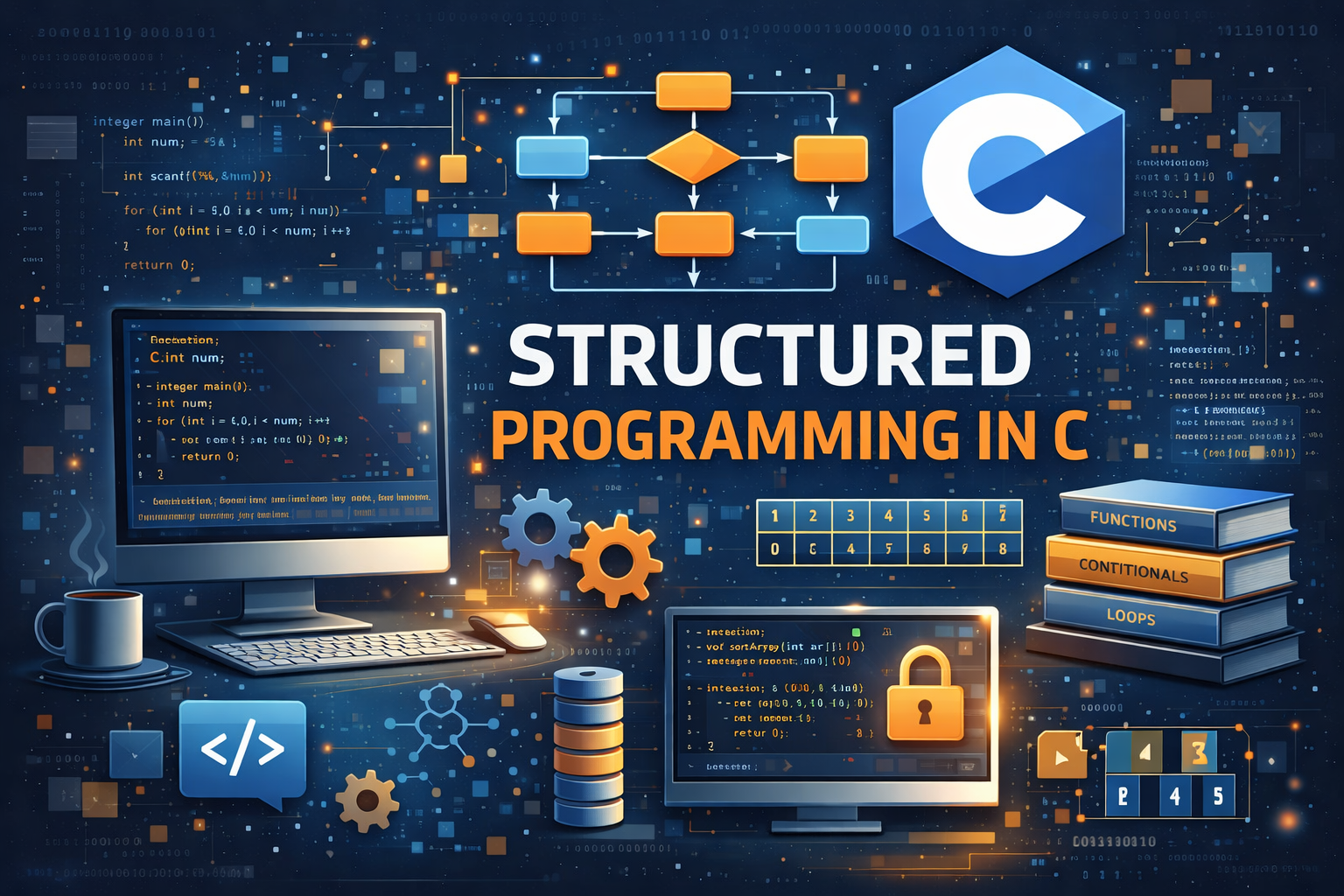
    • Structured programming in C is a programming approach that organizes code into clear, logical blocks using functions, loops, and conditionals. It focuses on improving readability, maintainability, and efficiency of programs. By breaking a problem into smaller modules, it becomes easier to develop and debug. This approach avoids the use of complex jumps like goto and promotes better program design. Structured programming is a fundamental concept for writing clean and reliable C programs.

      Course Content

      Chapter 1-Basic Concepts and History of C
      Basic computer concepts include understanding hardware and software, which are the core components of a computer system. Hardware refers to the physical parts like keyboard, processor, and storage devices, while software consists of programs that control and operate the system. Software is further divided into system software and application software. Operating systems manage resources and act as a bridge between user and hardware. Computers use different types of languages, including low-level and high-level languages, to execute instructions. The C programming language was developed in the early 1970s by Dennis Ritchie at Bell Laboratories. It evolved from earlier languages like B and BCPL. C was created to develop the UNIX operating system, making it powerful and efficient for system programming. Over time, it gained popularity due to its simplicity, flexibility, and performance. C became the foundation for many modern programming languages like C++, Java, and Python, and remains widely used today.

      • Basic Concepts of C Programming Explained for Beginners
        05:48
      • History of C Programming
        07:12
      • Exercise Basic of C
        06:14
      • Exercise History of C
        07:26

      Chapter 2-Data Types, Variable and Constants
      Data types in C define the type of data a variable can store, such as integers, floating-point numbers, characters, and more. Variables are named memory locations used to store data values during program execution. Each variable must be declared with a specific data type before use. Common data types include int, float, char, and double. Proper use of data types and variables helps in efficient memory usage and accurate program execution.

      • Data Types and Constants
        05:57
      • Variables, Keywords & Storage Classes in C
        06:51
      • Exercise Data Types, Variables & Constants
        08:37

      Chapter 3-Operators and Expressions
      Operators in C are symbols used to perform operations on variables and values, such as arithmetic, relational, logical, and assignment operators. Expressions are combinations of variables, constants, and operators that produce a result. They are used to perform calculations and make decisions in programs. Proper use of operators and expressions helps in writing efficient and meaningful code. Understanding operator precedence is important to ensure correct evaluation of expressions.

      • Operators in C Part 1 | Types & Arithmetic
        06:07
      • Operators in C Part 2 (Advanced Concepts)
        07:35
      • Exercise Operators & Expressions in C
        06:43
      • Exercise C Operators Concepts
        04:18

      Chapter 4 – Control Statements
      Control statements in C are used to control the flow of program execution. They allow decision-making and repetition of tasks based on conditions. There are three main types: selection, iteration, and jump statements. Selection statements include if, if-else, and switch. Iteration statements include for, while, and do-while loops. Jump statements include break, continue, and goto. These statements help in executing code logically and efficiently. They reduce complexity by avoiding repetitive code. Control statements are essential for building dynamic programs. They form the backbone of program logic in C.

      • Control Statements ( Types, if, if else…, nested if )
        07:56
      • Control Statements ( while, do while,for, nested for, switch… case)
        06:57
      • Exercise Control Statements (if.. switch)
        06:08
      • Exercise Control Statements (Looping)
        06:01
      • Exercise Control Statements (Ecological Simulation)
        05:55
      • Exercise Control Statements (Business Simulation)
        04:24
      • Exercise Control Statements (Loop-based solution)
        02:47
      • Exercise Control Statements (Switch case mapping)
        06:02
      • Exercise Control Statements (Hex support without functions)
        05:41

      Chapter 5 – Console I/O Statement
      Console I/O in C refers to input and output operations performed through the console. It allows users to interact with programs by entering and displaying data. Common input functions include scanf() and getchar(). Output functions include printf() and putchar(). These functions are defined in the standard input-output library . Console I/O is essential for basic program interaction. It helps in reading user input and displaying results. Proper formatting improves readability of output. Error handling can improve input reliability. Console I/O forms the foundation of user interaction in C programs.

      • Console I/O Statement
        07:46
      • Exercise Console I/O Statement
        05:45

      Chapter 6 – Array
      An array is a group of same-type data items stored in continuous memory locations. It is used to store multiple values in one variable. Array elements are accessed using an index starting from 0. Arrays can be one-dimensional or multi-dimensional. They make data storage easy and efficient but have a fixed size.

      • Array
        04:46
      • Exercise Array
        04:46

      Chapter 7 – Function
      A function is a block of code used to perform a specific task. It helps divide a program into smaller parts, making it easier to understand, reuse, and maintain. Functions can take inputs called arguments and may return a value. Common types are library functions and user-defined functions.

      • Functions in C | Basics & Types
        06:50
      • C Functions: Pointers & Recursion
        06:45
      • Exercise Function
        07:42

      Chapter 8 – Pointers
      A pointer in C is a variable that stores the memory address of another variable. Instead of holding a value directly, a pointer points to the location where the value is stored.

      • C Pointer Basics & Addressing
        08:51
      • Advanced Pointers in C
        07:26
      • Exercise 1 Pointers
        09:02
      • Exercise 2 Pointers
        09:06

      Chapter 9 – Structure
      structure in C language is a user-defined data type that allows you to group different types of data under one name. It is useful when you want to store related information (like a student’s details) in a single unit.

      • Structure (Basics , Memory mapping, array of structure)
        05:41
      • Structure, Union, Enum & Typedef in C
        04:45
      • Exercise Structure Part-1
        06:11
      • Exercise Structure Part-2
        08:16

      Chapter 10 – File Handling
      File Handling in C is used to store, read, and manage data in files (instead of just using memory). It helps in saving data permanently so it can be used later. Common operations: Create a file Open a file Read data from a file Write data to a file Close the file

      • Disk I/O – Part 1
        07:02
      • Disk I/O – Part 2
        07:12
      • Exercise File Handling
        08:53

      Chapter 11 – C Preprocessor
      The C Preprocessor is a tool that processes your code before the actual compilation starts. It handles special commands called preprocessor directives, which begin with #.

      • Preprocessor
        06:41
      • Exercise Preprocessor
        07:04

      Tags

      • C Programming
      • Control Structures
      • Functions
      • Pointers
      • Programming Fundamentals
      • Structure
      • Structured Programming

      A course by

      KM
      Kannan Madhesan

      Student Ratings & Reviews

      No Review Yet
      No Review Yet

      Course Includes:

      • Price:Free
      • Instructor:Kannan Madhesan
      • Lessons:40
      • Students:0
      • Level:Intermediate
      Wishlist

      Share On:

      Courses You May Like

      ChatGPT Image May 29, 2026, 02_57_07 PM (1)
      27 hours 33 minutes
      Intermediate
      AI Driven Object Oriented Programming
      (0.0/ 0 Rating)
      ₹2,999.00 Original price was: ₹2,999.00.₹2,499.00Current price is: ₹2,499.00.
      • 7 Lessons
      • 0 Students
      Intermediate
      AI Driven Object Oriented Programming
      (0.0/ 0 Rating)
      ₹2,999.00 Original price was: ₹2,999.00.₹2,499.00Current price is: ₹2,499.00.

      Course Description🤖 AI-Driven Object-Oriented ProgrammingAI-Driven Object-Oriented Programming (OOP) is an advanced approach that combines the power of Artificial Intelligence 🧠 with modern programming concepts 💻...

      • 7 Lessons
      • 0 Students
      Enroll Now
      AI_Alia_LMS_logo

      Empowering innovation through AI training,research and development. Focused on Agentic AI, Quantum AI, and advanced technologies.

      Add: 161, 10th Cross, HBR 5th Block, Bangalore-560043
      Call: +91 9443202391
      Email: support@ai-alia.com

      Online Platform

      • Course
      • Events
      • Instructor Details
      • Purchase Guide

      Links

      • Gallery
      • News & Articles
      • FAQ’s

      Contacts

      Enter your email address to register to our newsletter subscription

      Icon-facebook Icon-linkedin2 Icon-instagram Icon-twitter Icon-youtube
      Copyright 2026 AI ALIA | Developed By AI-ALIA. All Rights Reserved
      ai-alia.comai-alia.com
      Sign inSign up

      Sign in

      Don’t have an account? Sign up
      Lost your password?

      Sign up

      Already have an account? Sign in
      Hi, Welcome back!
      Forgot Password?
      Don't have an account?  Register Now